Patient acquisition benchmarks for solo practices
The 2026 benchmarks show that solo practices without a growth system typically add 5 to 8 new patients a month, while those with local SEO, reviews, and easy booking reach.
- See exactly what brings in new patients.
- Track your growth month over month.
- Decide with data, not guesswork.
14-day free trial · No credit card required · Built for solo practice
About these benchmarks
These benchmarks describe patient acquisition for solo healthcare practices in 2026, drawing on industry studies and aggregated Clinexy practice data. Figures are typical ranges to guide planning, not precise universal values.
Acquisition is often treated as luck. The benchmarks show it follows a predictable system: get found, get chosen, get booked.
The headline numbers
What the 2026 data shows for solo practices.
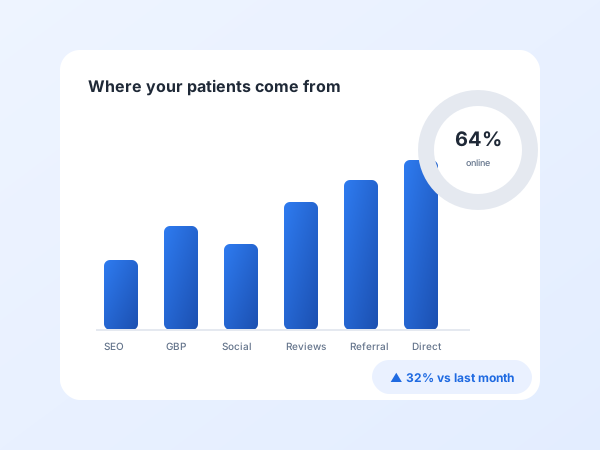
Where patients come from
For most solo practices, the path to a new patient is digital and local.
- Local search and the Google map pack.
- Reviews that decide who patients choose.
- A website that converts the visit to a booking.
- Referrals and word of mouth from retained patients.
The channels reinforce each other over time.
What good growth looks like
Benchmarks help you judge whether your growth is on track.
- First map-pack movement in 4 to 8 weeks.
- 50 or more reviews within 90 days.
- Top-three local ranking in 6 to 12 months.
- A steady inflow of 30 or more enquiries a month at maturity.
The shape of this timeline is in how to get more patients.
The biggest levers
Not all acquisition work is equal. The data points to a clear order.
- Being found: a complete profile and a real website.
- Being chosen: a steady flow of recent reviews.
- Being booked: an easy, branded booking page.
- Being kept: recall that turns one visit into many.
The found stage starts with local SEO.
Benchmark and grow your practice
"I had no idea if five new patients a month was good. The benchmarks showed me what was possible, and a year later I was well past it."
The bottom line
A solo practice does not grow by working harder across scattered tools. It grows by connecting the work, so that booking, records, reminders, your website, reviews, and recall all pull in the same direction from one record. That is the difference between a busy week and a genuinely growing practice.
Whatever brought you to this page, the next step is the same: put the pieces on one platform, from online booking through to a clear plan to get more patients, and let the basics run consistently. The trial is free, migration is same-day, and there is no contract, so the honest way to see it is to try it on your own practice.
What good looks like: a realistic timeline
Whatever you are setting up from this page, results are steady rather than sudden. Knowing the shape of a normal timeline helps you keep going through the early weeks when the work is still building underneath the surface.
Weeks 1 to 4. Setup. Your website goes live, your Google profile is completed, and reminders, reviews, and recall are switched on. Little is visible yet, but the foundations are in place.
Months 1 to 2. First movement. Your profile starts appearing for local searches, the first automated reviews arrive, and no-shows begin to fall as reminders take hold.
Months 3 to 6. Momentum. Reviews build into a steady flow, service and area pages begin ranking, and recall brings lapsed patients back. New patients increasingly say they found you on Google.
Months 6 to 12. Compounding. Most solo practices reach the local top three for their core terms, the review count passes fifty, and a predictable inflow of new patients replaces the old feast-and-famine pattern. The practices that win are simply the ones that keep the basics running, which is exactly what Clinexy automates.
Common mistakes to avoid
Most practices lose ground for a handful of avoidable reasons. Watch for these.
- Treating growth as a one-off. It is ongoing upkeep, not a single push that fades.
- Renting instead of owning. Relying on a directory leaves you beside every competitor with nothing that says why you.
- Inconsistent details. A different phone or address across the web tells Google not to trust you.
- Asking for reviews in bursts. A one-off flood looks unnatural; a steady, recent flow ranks.
- No clear next step. Every page should make booking one tap away.
- Stopping when busy. The practices that win keep the basics running consistently.
Why a connected practice grows
Whatever the topic of this page, the underlying lesson for a solo practice is the same: growth comes from a connected system, not a single tool. When booking, records, reminders, website, reviews, and recall all read from one patient record, the work starts to compound instead of leaking.
Picture the loop. A patient searches nearby and finds you, because your profile and website rank locally. They choose you, because your story and a steady flow of recent reviews build trust. They book in a few taps, and a reminder sequence makes sure they attend. After the visit, an automatic request earns a review and recall brings them back when due. That review lifts your ranking, which helps the next patient find you, and the loop turns again, a little faster each time.
Separate tools break the loop at every handoff. A booking that does not trigger a reminder becomes a no-show. A happy visit that is never asked for a review becomes a missed five stars. Hours disappear re-typing the same details from one app into another, and the compounding never starts.
That is the whole case for an all-in-one platform, and it is usually cheaper than the separate tools it replaces. It is why the templates, guides, and results on this site all point back to the same place: one system, one record, and a practice that grows quietly in the background.
Get started in a day
No technical skills and no long onboarding. Most practices are running this within a day.
Import your patients
Upload a CSV in about 10 minutes, or use guided migration from Practo, SimplePractice, Cliniko, Jane, or MocDoc, with a specialist checking it with you.
Switch on automation
Turn on reminders, reviews, and recall so the repetitive work runs in the background from day one.
Publish your website
Pick a healthcare template and go live on your own domain in about 30 minutes, with booking and local SEO built in.
Prefer it handled for you? The Done-For-You tier runs the growth work on your behalf.
Built for every solo practice
The same platform adapts to your specialty, with workflows tuned to how you actually work.
- Solo doctors and GPs
- Dentists
- Therapists and psychologists
- Physiotherapists
- Dermatologists
- Pediatricians
- Nutritionists and coaches
- Ayurveda and holistic
Browse every practice type on the solutions overview.
Secure, compliant, and yours to leave
Your patient data is protected to a high standard. Records are encrypted with AES-256 at rest and TLS 1.3 in transit, access is controlled, and your information is exportable at any time and never sold. One honest plan covers everything: 999 rupees a month in India or 99 US dollars globally, with no commissions and a 14-day free trial.
Read more on security and the pricing page.
How Clinexy helps
Clinexy turns these benchmarks into an acquisition system.
- Automated workflows. Reminders, reviews, and recall run on their own.
- One platform. Operations and growth on one record.
- One dashboard. See results in a single place.
- Done-For-You. Hand the growth work over if you prefer.
Explore the full platform or see it set up for your practice type.
Everything in one subscription
The tools here are part of one platform, on a single plan that usually costs less than the separate tools it replaces.
- Online booking and reminders
- Recall and follow-up automation
- A branded website on your domain
- Local SEO and Google profile sync
- Automated review collection
- Personal branding tools
- Telehealth and patient records
- Billing, invoices, and superbills
See the full platform on the features overview, or compare it on the comparison hub.
Frequently asked questions
How many new patients should a solo practice get?
Where do new patients come from?
How long until I rank locally?
What is the biggest lever?
How many reviews should I aim for?
Do I need to run ads?
How do I know if my growth is on track?
Where does this data come from?
How do I apply the benchmarks?
Can I track my own metrics?
Summary
The 2026 benchmarks show acquisition is a system, not luck. Key points:
- Without a system: 5 to 8 new patients a month.
- With one: 30 or more enquiries a month at maturity.
- Top-three local ranking in 6 to 12 months.
- Being found and chosen are the biggest levers.
- Owned channels compound over time.
Grow against the benchmarks
Start free today. An acquisition system built on what works.